Who I am and what my mission is.

I spent ten years making cheese in the US before beginning to travel globally volunteering with cheesemakers and herders in 2019. I wish to document the intersection of traditional and modern techniques, and portray the global diversity of dairying, cheesemaking, and grazing practices. In doing this I want to show how the final cheese is the end product of a complex series of relationships and decisions made by humans, that are embedded in a a cultural, geographic, and climatic setting. I advocate for raw milk, a natural starter cultures, heritage breeds, regenerative or ecologically responsible grazing, and the right of all humans to ferment milk in their own homes, selling in local markets. In order to further my mission I am writing a book, and hope to build an online archive, a global database of cheese, dairy, and grazing knowledge. I would love to talk with anyone interested in hosting me anywhere in the world and hearing about how you do things.

Tuesday, April 19, 2016

The Cellars At Jasper Hill


In April I began a new job at Jasper Hill Farm in the Northeast Kingdom of Vermont.  I started in The Cellars doing affinage in this amazing facility.  Seven Vaults are build in the side of hill and buried to maintain temperature through Vermont's barbaric winters.  The cheeses above are Alpha Tolman an Alpine cheese that develops a smear from constant brine washing.  


The washed rind vault houses Willoughby and Oma.  Oma is made by Von Trapp and the model of The Cellars is to buy and age cheeses not only from Jasper Hill, but also of other nearby producers, mimicking the European model of affinage.  Cheeses are kept on wire rack towers with rolly bases and washed frequently.  It smells very good in this Vault, each has its own aroma as well as temperature and humidity. 


Bayley Hazen Blue is a fascinating cheese to watch age.  It starts in a warmer wetter Vault then after the blue covers it is moved to a cooler dryer vault.  Each wheel is hand pierced with a single hole piercer giving it a varied less mechanical look inside.   Naturally rinded blues are a favorite of mine and getting to see this cheese develop and taste it as it did is a valuable experience.  


My experience the Cellars has widened my  knowledge of cheese exponentially.  I have gotten to learn so much about affinage, sensory evaluation, rind care, and the logistics of managing cheese aging/selection/shipping.  Affinage is my favorite aspect of cheese making, this is where the magic happens.  The cheese comes in fresh virgin white, a blank canvas.  Microbial artists comes in  and are steered by human hands into an artistic symbiosis of human, animal, land, and microbes.   There is really nothing else like it in the USA and I am glad to say I got to dive into this amazing place.  

Thursday, March 10, 2016

Visit to Cricket Creek Farm


I visited Cricket Creek Farm in the Berkshires of Massachusetts and got to see the cheese making facility there. It is a gorgeous diverisfied farm with an onsite store and bakery.  I had a blast meeting everyone who works there, tasting farm products, and making cheese.   


The aging room is my favorite part of any cheese tour.  All aging rooms smell similar but slightly different.  They all smell like musty cellars but each has a unique aroma probably due to the particular balance of microbes, the climate and humidity, and the amount of airflow.  

Gorgeous Jersey cows on pasture. 

The quaint farm store where you can buy cheese, raw milk, bread and other goods baked onsite, meat, and products from other surrounding farms.  A strong community farming spirit in the Berkshires.

Monday, June 23, 2014

Aging Pecora


2 weeks, white yeast
5 weeks  some blue and black molds, earlier yeast patted down.

Pecora is a loooong aged raw sheep milks cheese.  It is sold at 10 months as a more mild semi hard cheese and 18+ months as a sharp dry hard cheese.  The younger wheels have a lactic tang to them and are pleasantly sheepy with some deeper/sweeter flavors developing.  The older wheels have a butterscotch sweetness, with bold fruit flavors and some earthiness near the rind.  I like taking real old dry Pecora and grating it on things.

6 month, full developed mottled looking  rind, blue grows on waxy feeling surface

10 month, the spotty wind tufts visible on right is Geo, It gets rubbed into the rind making it waxy
The cheese is hooped in cheesecloth and the rind has random artisan looking grooves on it.  It gets washed with brine for the first few months until the rind looks ready.  From then on it will be brushed frequently to keep mite damage at a minimum, but the natural rind will continue to develop.  I like to encourage the faint white greasy Geotrichum candidum that shows up on many naturally rinded cheeses after a few months aging.  It is indigenous meaning not added to the milk but is already present in the environment airborne or in the milk itself. It is a fungus with mold and yeast like forms that is common worldwide.  It could fall into the milk and express later but I imagine it is airborne in the aging cave and cannot colonize until a later phase in the succession of rind ecology.

The geo sticks to the rind better than the dusty blues so when you brush them the blue comes right off and some of the geo presses in. After 8-10 months you can mainly rub that geo in and it builds up a thick waxy feeling rind that seems to protect the cheese from cracking and drying out as well as inhibit anything else from growing.

14 months, cheese is hard and dense, beautiful orange scarred milky veteran 
2 years, rind is pitted from mites but under the thick cellar tasting layer is wonderful cheese

Monday, May 12, 2014

May 12th Snow Storm


  It snowed last night and into today, I took some photos while milking and feeding. Is it Spring yet?


Monday, March 24, 2014

Fruition Farms Larkspur Colorado


1st night On The Road, Big Sur
 
I left California in April 2013 to go on the road and seek greener pastures.  After a few months
living out of my modified minvan in the southwest and doing backpacking trips I visited Fruition Farms in Larkspur Colorado.  I met with owners Jimmy Warren and Alex Seidel, made some cheese and helped with milking.  After this I went to spend sometime in my hometown of Port Orchard WA.  I had expressed interest in working at Fruition and I got a job offer which I accepted and spend another month on the road getting out to CO to start work in November.


Cold morning on the farm, frozen frost.

Winter was getting started when I showed up and we had some good long frosts.  I learned how to take care of feeding the sheep, doing farm chores and making cheese once a week.  I live out on the farm in a small apartment with a wood burning stove.  I'm very excited to be out here, part of a good company, working with awesome people.  We are having lambs right now and have just started milking again, making cheese regularly.  I'm juiced!!

My buddies, the yearling rams
 

Sunday, September 15, 2013

Ranch sitting near Leavenworth WA


While I was spending the summer working and hanging out in western Washington I got a chance to spend a week over in Eastern Washington taking care of a friends sheep ranch.  I did the daily milkings, moved the herd around various orchards which also serve as pastures, and made some cheese. The climate is warm and dry, I was out here for the hot days of early September and would drive up the icicle to climb and hang out on the river.


Wednesday, August 22, 2012

ACS Conference 2012


In the first days of August I flew out to Raleigh North Carolina for the annual American Cheese Society Conference and Festival of Cheese.  Three days of classes, workshops, and tastings preceded an awards ceremony and festival in which all the cheese entered was out for display and sampling.  It is a great networking opportunity and way to get people together to exchange ideas and discuss common problems and solutions.


 I learned a lot from an alpine cheese making demonstration which I attended.  I realized some very basic things that I had overlooked regarding the effect of cutting curd and rate of cooking on final firmness.  The harder the curd is at the time of cutting, the softer the final product will be because the curd will have less time to expel whey when firming up.  So for a harder cheese your cut when still relatively soft, which is counter intuitive but logical.


We entered 4 cheeses and our Feta received a 3rd place award in the category of Sheep's Milk Feta.  It was great to be able to check out Raleigh which as a great beer/food scene going on.  I enjoyed representing the company and our cheese, learned a lot, and met a lot of great folks!!

Tuesday, June 5, 2012

New Shelves


In order to house our record production this year I designed some new shelves that can hold vertical wheels, a more space efficient method than horizontal wheels on standard shelves.  They are in the more dry half of the cave where we put cheese after a few months to finish aging.  This room is definitely crowded, but I ventilate it thoroughly and I feel the older cheeses don't suffer as much from lack of breathing room. I try to cycle them through the cave to compensate for localized differences in airflow and humidity.  Ideally you could have air piped in to PVC pipes running vertically down the middle of these racks with drill holes spaced periodically to provide more even airflow.


The wheels seen on these new shelves are our Daisy Tommes which are made from early season Sheeps milk. Turning cheese on these shelves is fast and easy, a 1/4 turn every 3 days.  It really pays to make sure all the wheels come out with even sides if you expect them to stand on end with falling over in a domino like cascade.  Tags are tacked to first and last cheese of every batch with make info and tasting notes.


Sunday, February 19, 2012

My name is Bubba and I'm a Dog!!


Bubba is our guardian, he lives with the flock and has a very loud bark to scare off any predators. He is a Great Pyrenees which is an ancient breed the lineage of which can be traced back 10,000 years to the earliest domesticated dogs. Isolated in the Pyrenees mountains these dogs are used by basque herders who appreciate the dogs ability to live outside in harsh conditions. They have an warming insulating undercoat and a thick water resistant outer coat of white fur that allows them to weather the toughest climates and blend in with the flock. Great Pyrennes are nocturnal animals, sleeping most of the day but spending the night patrolling and barking at anything they might find threatening. They integrated themselves with a flock quiet readily and need no training to do their jobs, its deeply ingrained genetic memory.


Thursday, January 26, 2012

The Lambs are not silent


With January comes lambs in waves of white fleece and thunderous bleating. Sheep will produce milk for 6 months following birthing, all the new life equals lots of milk, the essential liquid of life. After staying with their moms for three days drinking the colostrum which is the initial dose of milk with exceptionally high amounts of minerals and nutrients, the lambs are separated into pens and the mamas head for the milking line-up. The lambs will be hand fed from bottles until they learn to suckle off a bucket easing the task of feeding the pesky buggers with their voracious appetites.


Lambing is a very busy time of year but its all this new life that graces us with our milk, that sweet elixir that will eventually become a beautiful tasty wheel of cheese. Life is a fleeting thing and milk quickly sours and rots away but when a little human ingenuity intervenes the process of decomposition can be delayed, leading to the incredible diversity of artfully crafted cheeses. Making cheese is kind of like playing god, utilizing natural phenomena and microbiological manipulation to create the most exquisite of foods. Cheese is the meeting place of life and death.

Kind of went off on a tangent there but I think this gets close to the nut of the issue. This life of farmstead cheese making is a way to reconnect with natural cycles that most of us in this country have moved away from. Its a connection to the land, the seasons, the weather, animals, other humans, and the circle of life and death which really is the bedrock of reality. It is a hard life that doesn't really pay off in an economic sense but is fulfilling in a spiritual sense because it offers a whole integrated existence somewhat removed from the ordinary options of an eight hour day at work away from home. It is this that lead me to say that cheese is life.

Friday, December 23, 2011

Kurtwood Farms visit


 On my Christmas vacation to Washington I visited Kurt Timmermeister, owner of Kurtwood farms and maker of Dinah's cheese, a small bloomy rind cheese reminiscent of Camembert.  The farm is on rural Vashon Island, a ferry ride away from Seattle and my hometown on Kitsap pennisula.  Kurt has a dozen our so cows, a rustic farmhouse, dairy, and cheese cave on 13 acres.

The cave was amazing, it was built of extensively reinforced concrete with a barrel vaulted ceiling then buried under 4 feet of soil.  It maintains a temperature around 50 degrees and houses a Italian style grating cheese that Kurt is developing.  There is also a building with a kitchen and large dining area where farmhouse dinners were held in the early days of the farm.  I like his approach of making one cheese very well, and these little bloomies are certainly difficult cheeses to perfect.  The cheese is splendid and it was very nice to see someone running a small scale farmstead operation in the Puget sound.  


Photo credit Emily Warmedahl

Thursday, December 22, 2011

Monarch - Beer washed Cows milk cheese

Monarch Wheel at 2 weeks

We have just released a pair of new cows milk cheese that I spent September and October working on.  The first is called Monarch and is a trappist style cheese which we are washing with a brown ale from Santa Cruz Mountain Brewery.  This style is a semi-hard washed curd cheese, meaning that we pull some of the whey out and add hot water during the cook, reducing the rate of acidification and creating a softer cheese, Monterey Jack has a typical washed curd texture.  These trappist cheeses originated in Bosnia but are made in Hungary and Germany as well, and the style we base Monarch on are those made in German Trapppist monasteries, which generally also make beer.  This subset of the Trappist family is typified by washing with beer, and the growth of a b. linens smear, lending a pungency and softening of the paste through proteolysis.

Five Weeks
 The milk for this cheese comes from the Schoch family, who have a ranch near by in Salinas.  They bring us the milk still warm from the morning milking, It dosn't get more fresh than that.  Monarch is made in wheels smaller than our sheeps milk cheeses, It will ripen after only 2-3 months that way.  It is also softer than our other cheeses, and is washed regularly with first a brine to stimulate the growth of B. Linens, then with beer to add a distinct flavor and keep molds off.

9 weeks, ready for sale

Friday, October 28, 2011

Cheese Defects Workshop

On September 13th I attended a workshop taught by Moshe Rosenburg in which we discussed how to respond to the imperfections that can commonly arise in cheesemaking. His is approach was very scientific, emphasizing the use of very accurate measurement of aciditiy and temperature and making minute adjustments, especially during the process of syneresis.  Syneresis  a stage in the cheesemaking process which begins after the cut when the curd begins to expel whey, and lasts until the cheese is brined. During the intervening steps of cooking draining hooping and pressing small variations can be used to adjust moisture content.  Being able to take accurate measurements and control the rate of syneresis can help you address issues found in the final product and is the first step in creating a consistent cheese.


We also discussed the chemistry of flavor development.  During aging, flavor development takes place through the metabolic activity of microorganisms and enzymes originating from the milk, rennet, starter, secondary microflora (yeasts, molds, bacterias), and non-starter lactic acid bacteria (NSLAB).  There around 60 enzymes that occur naturally in milk and many survive the cheesemaking process.  Most of the starter culture that is added dies off but in doing so releases enzymes.  The flavor of a cheese can be explained by identifying flavor compounds that are released during aging mainly through two biochemical events: Lipolysis and Proteolysis.
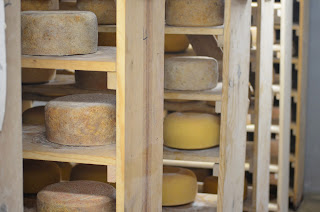
Lipolysis is the catabolism (breakdown) of fat in milk by lipases.  Lipases are enzymes that hydrolyze fat triglycerides, breaking them into fatty acids which can follow various pathways to create flavor compounds.  For most cheeses, the creation of free fatty acids is as far as the process goes, but in cheeses with high levels of lipolysis (blues, some Italian cheeses) further breakdown occurs.  Unsaturated fatty acids can undergo a secondary metabolism involving oxidation into aldehyes which flavor compounds.  Hydroxy fatty acids can become lactones which are a specific type of ester found in low levels in cheddars and high levels in blues.  Ketoacids can be oxidized into methyl ketones which are found extensively in blues as a result of lipolysis by P. roqueforti, a commonly used blue mold.  Levels of lipolysis vary, raw milk cheese will have more potential because pasteurization kills lipoprotein lipase, which is indiginous to milk.  The rennet paste used in some hard Italian cheeses contains pregastric esterase (PGE) which is a potent lipase.  B.linens, the bacteria which characterizes washed rind cheeses, contains intracellular lipases and esterases which contribute to lipolysis.

Proteolysis is the breakdown of protein into peptides then amino acids and finally amino acid catabolites.
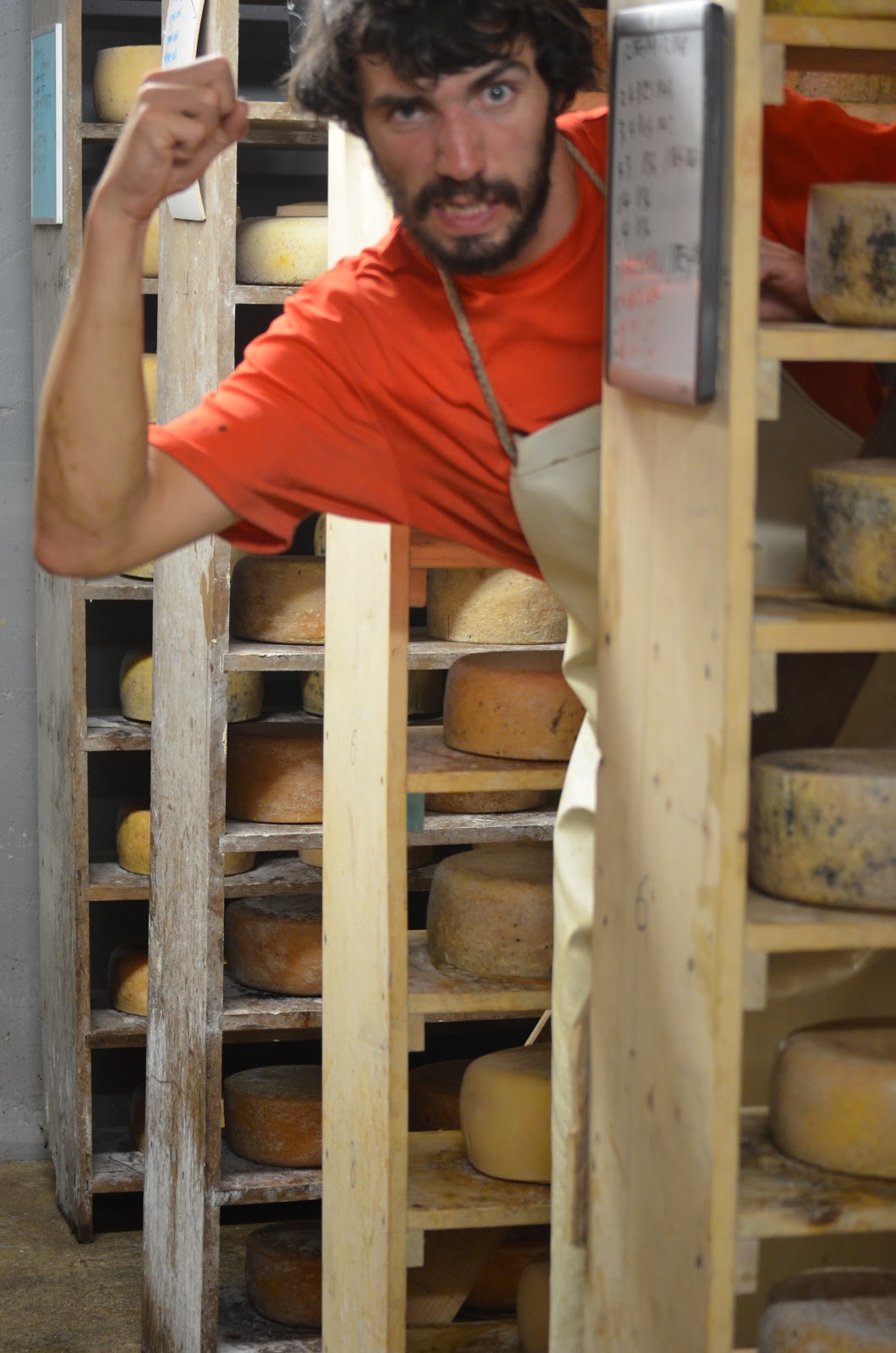
There are multiple sources of proteases (enzymes that breaks protein down into peptides, which are amino acid chains).  Chymosin is an enzyme in rennet that is a principal protease in most cheeses. Plasmin is a component of blood that is also an indigenous milk protease. After these two have done the initial work of breaking protein into peptides further breakdown of peptides into amino acids takes place through the action of peptidases.  Starter cultures contain intracellular peptidases which are released into cheese after they die.  Thermophillic cultures die and lyse quickly, resulting in high levels of amino acids in cheese utilizing this type of culture.  Cheeses which use secondary microflora as a primary ripening catalyst (washed, bloomies, blues) get most of their proteolytic activity from their respective microorganisms.  The free amino acids that result from the preceding events are catabolized (broken down) into amino acid catabolites, many of which have been identified and linked to aromatic sensations, which is what we really care about in the end.  Extent and source of  Proteolysis is also a decisive factor in the texture of cheese, so understanding this process is a must.